-
Mob.:+86 186 3280 7688
-
E-mali: sales@dswirecloth.com
Mob.:+86 186 3280 7688
E-mali: sales@dswirecloth.com
Sep. 04, 2026
Cooperation with Stainless Steel Filter Manufacturers
The customer is a professional filter manufacturer whose products include sintered mesh filter elements and sintered felt filter elements, which are widely used in filtration systems in industries such as petroleum, chemical, metallurgy, and environmental protection. As downstream customers continue to raise their requirements for the appearance quality and filtration accuracy of filter products, this customer has imposed stricter control standards on its upstream stainless steel mesh suppliers.
The customer is procuring sintering mesh face mesh (specifications include woven wire mesh 0.154/0.10, 0.45/0.18, 0.4/0.25, etc.) and sintering felt face mesh (specifications include 0.4/0.25, 0.4/0.23, 0.45/0.18, 0.4/0.13, etc.), with a material requirement of 316L stainless steel. Based on two national standards, GB/T5330 "Industrial Metal Wire Woven Square Hole Screen" (international standard ISO9044) and GB/T17492 "Technical Requirements and Inspection of Industrial Metal Wire Woven Mesh," the customer has specified clear technical requirements for the control of major defects, color difference management, and cleanliness of the face mesh.
Customer core quality requirements
According to the "Quality Requirements for Stainless Steel Wire Mesh" document provided by the customer, the core requirements can be summarized into the following three aspects:
1. Major Defects and Color Difference Control
"Major defects" include creases, holes, sparse weft threads, rust spots, broken wires, loops, top knots, weft shrinkage, twisted wires, skipped wires, loose wires, foreign matter incorporated into the weave, sparse warp threads, and tears. "Color difference" refers to the visually uneven phenomenon caused by abrupt changes in the texture along the warp and weft directions of the metal wire square mesh.
The customer has different requirements for the two types of mesh:
- Sintered wire mesh: The total number of major defects and color differences per roll shall not exceed 3, and continuous defects such as sparse lines and color differences are not allowed to occur in the warp direction. The supplier shall mark the defect locations with a black marker in advance and list the defect details on the certificate of conformity.
- Sintered felt face netting: In principle, major defects and color differences are not allowed; if unavoidable, the supplier must mark the product with a black marker. One defect is recorded within ±200mm of the defect location, and 1m of the effective length is deducted for each defect; the product is accepted based on the effective length.
2. Cleanliness requirements
The customer requires that the cleanliness of the wire mesh be determined by wiping three points on the mesh with white clean filter paper; the filter paper should remain oil-free and uncolored to indicate it is (qualified). The customer has clearly listed a list of qualified cleanliness suppliers in the document, and our factory is included on the list due to our stable cleanliness control capabilities.
3. Dimensional and tolerance control
Each roll of product shall have a continuous warp dimension of not less than 30 meters. The tolerance for wire mesh weight per unit area (kg/m²) and wire mesh thickness (mm) shall be ±5%.


Dashang Wire Mesh 's solutions and quality control measures
1. Source control – Raw material inspection
Our factory has established a strict incoming material inspection system, verifying the material, diameter, and tensile strength of each batch of 316L stainless steel wire before warehousing. Each batch of raw materials is accompanied by a material certificate from the steel mill, and undergoes secondary spectral testing upon arrival at the factory to ensure that key indicators such as nickel content meet the standard requirements.
2. Process Control – Weaving Process Management
During the weaving process, key indicators such as mesh deviation, weft skew, and wire breakage rate are recorded and dynamically adjusted throughout the process by the on-duty quality inspector. In response to customers' high requirements regarding warp continuity defects such as color difference and uneven weave patterns, our factory has strengthened the monitoring of warp tension during the weaving process, effectively reducing abrupt changes in warp patterns.
3. Factory Inspection – Full Inspection and Defect Marking
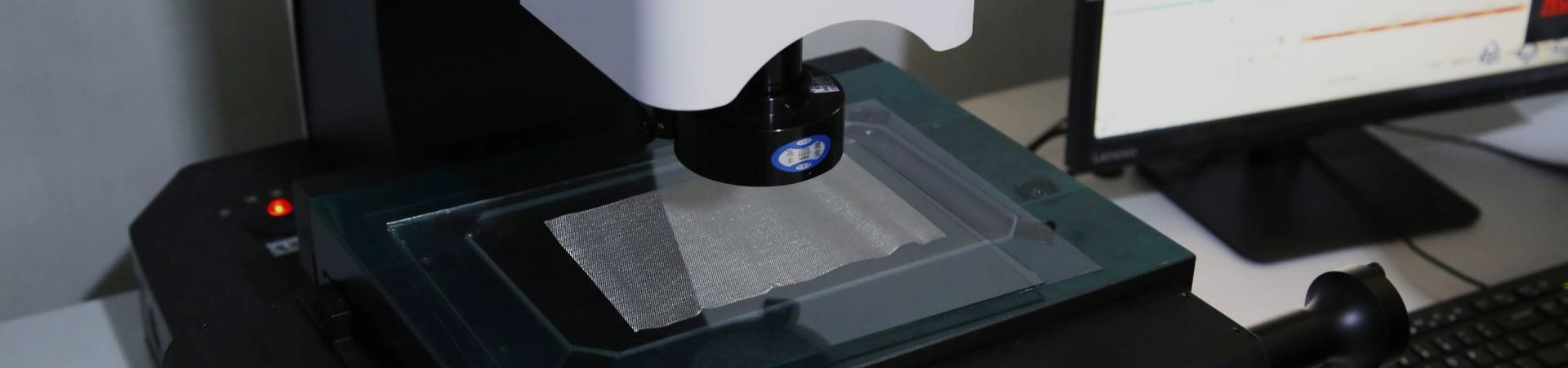
Each roll of product undergoes full inspection according to GB/T5330 standard before leaving the factory. For sintered mesh:
- Count the total number of major defects and color differences for each roll of product, ensuring that they do not exceed 3;
- Mark each defect location with a black marker;
- Each roll of product is equipped with a unique serial number and a certificate of conformity, which details the defects.
For the face net of sintered felt, our factory has further improved the weaving precision during the weaving process, controlling the occurrence rate of defects and color differences to the lowest level; for unavoidable individual flaws, they are also marked and the effective length is deducted according to the customer's requirements.
4. Cleanliness Guarantee
After the wire mesh is woven, our factory adds a special cleaning process and uses white clean filter paper to wipe three points on each roll of product to ensure that the white filter paper is free of oil and does not change color before it is put into storage. This standard has been approved in writing by the customer, and our factory has been included in the customer's list of qualified cleanliness suppliers.


Cooperation Results
Through the establishment and implementation of the above quality control system, our factory has been able to reliably supply customers with multiple batches of wire mesh products that meet technical requirements.
- Defect control meets standards: The number of defects and color differences in all delivered products is controlled to no more than 3 per roll as required by the customer;
- Stable cleanliness: The cleanliness of each batch of products is tested by wiping with white filter paper, and there is no oil stain or discoloration problem;
- Full process traceability: Each roll of product is equipped with a unique number and a detailed list of defects, which makes it easy for customers to accurately identify and avoid defective areas in the production sintering process, effectively reducing customers' production losses and complaint rates.
Currently, our factory has been supplying the filter manufacturer as a qualified cleanliness supplier, and the two parties have established a long-term and stable cooperative relationship.
This case study demonstrates that in the niche market of high-end filter mesh, suppliers not only need stable weaving capabilities but also require a systematic quality control system encompassing defect management, cleanliness assurance, and end-to-end traceability. Dashang Wire Mesh successfully met the stringent technical requirements of our customers for sintered mesh and sintered felt filter mesh through rigorous raw material inspection, process control, final inspection, and dedicated cleanliness assurance. This also provides a valuable supply service model for other filter manufacturers in the industry.
Need a Custom Solution?
Dashang Wire Mesh has established a standard process for drawing and annealing wires, weaving mesh production and deeper processing, and inspection.
Related Products